

Industry associations, AI experts, and educators identified early adoption and training as key to unlocking the potential of agentic AI, which is seeing widespread adoption across various sectors.

The recently concluded 8th GAIN National Convention, organized by the Government-Academe-Industry Network, Inc. (GAIN) at the AIM Conference Center Manila last August 29, gathered representatives from the public and private sectors as well as the academe to discuss agentic AI, a form of artificial intelligence that goes beyond generating content and is capable of performing tasks without human oversight.
With the theme “Shaping Tomorrow: Gaining Momentum in the Era of Agentic AI,” the convention highlighted several case studies wherein agentic AI has been seamlessly integrated into education, business processes, and decision-making.
JL Botor, vice president of the Healthcare Information Management Association of the Philippines, shared that the healthcare industry abroad, which the local sector primarily caters to, has already applied agentic AI in automating clinical support, patient monitoring, and documentation.
Ida Tiongson, member of the Board of Trustees of the Fintech Alliance.Ph, noted that AI in its broader sense, has improved the customer experience and has the potential to detect fraud more effectively in the banking industry.
Doc Ligot of PAIBA reveals that the adoption rate of agentic AI among Philippine BPO companies is three times higher than the global adoption rate.
A rising number of BPO companies in the country have also integrated AI into their operations. Citing recent data from the IT & Business Process Association of the Philippines, Doc Ligot of the Philippine AI Business Association said that 11% of BPO companies in the country have already fully adopted agentic AI, with 56% actively integrating it into operations. He added that the number of BPO companies that fully adopted agentic AI is three times higher than the global adoption rate of 4% reported by Deloitte.
Rex Wallen Tan, Chief Technology Officer of Southville Global Education Network, explained that agentic AI has the potential to become even more sophisticated in the coming years. “Agentic AI is more likely to get better, as with how generative AI became better than everyone expected two years ago. Early adopters of this technology are poised to be in an advantageous position once agentic AI becomes part of daily life,” Tan explained.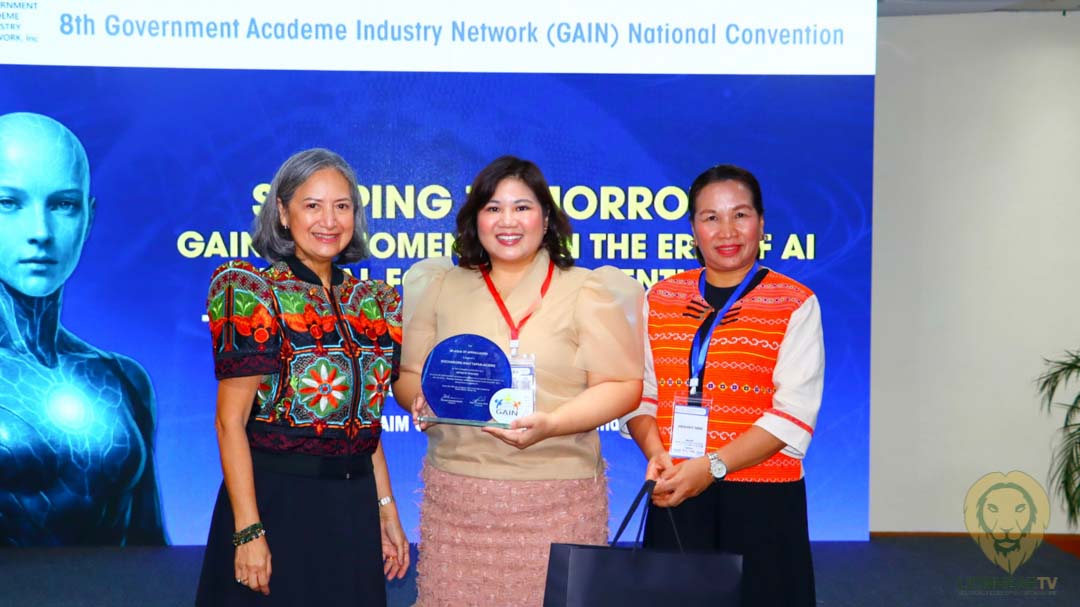
GAIN President Monette Iturralde-Hamlin and Secretary Jocelyn Tizon with SEAMEO Innotech Deputy Director Kochakorn Khattapan-Acidre (center), who called for a shift in learning amidst the rise of agentic AI.
Aligning priorities and goals
Experts have long dispelled fears of job displacement due to AI. A 2020 report from the World Economic Forum explained that while 85 million jobs may be displaced, over 97 million new jobs will be created as AI adoption becomes more widespread.
Deputy Director Kochakorn Khattapan-Acidre of SEAMEO Innotech, called for a shift in learning goals, prioritizing creativity, critical thinking, and collaboration, in response to the fast-changing pace of technology.
However, Dr. Raymundo Arcega, chairman of the National Network of Quality Assurance Agencies, noted that the government, academe, and industry sectors have long suffered from misaligned priorities. Haidee Enriquez, president of the Contact Center Association of the Philippines, expounded that technological advances compel industries to adjust quickly, but the bureaucracy in the education system hinders the curricula from adapting accordingly.
Francis Aldrine Uy, founder and president of USHER Technologies, suggested that academic institutions should see themselves as more than teaching institutions and explore how agentic AI can be utilized in realizing an outcomes-based education system. Mike Lao, Data and AI lead for Accenture Philippines, also noted the need for a workforce with technical capabilities that are also adept in the new skillsets required for emerging roles.
(From left to right) GAIN officers, including VP for Industry Linkages Grace Abella-Zata, Secretary Jocelyn Tizon, President Monette Iturralde-Hamlin, Executive Director Genevieve Ledesma-Laurel, VP for Government Linkages Raymundo Arcega, and Director Rex Wallen Tan lead this year’s GAIN National Convention.
Several business executives and academic officials, during a luncheon meeting on the sidelines of the convention, also identified the current skills gap among graduates and proposed changes to the General Education curriculum to prepare students for an AI-powered industry.
“A multi-sector collaboration has already yielded programs that can hone global competitiveness in Filipino students, and there is an opportunity to do the same to prepare them for the widespread adoption of agentic AI. However, there is also a need for the government, academe, and industry to ensure its proper and ethical use and, more importantly, not to let go of the human touch for the sake of technology,” GAIN President Monette Iturralde-Hamlin said.
For the past years, GAIN has been fostering synergy among the public and private sectors and the academe, which has since led to initiatives aimed at equipping students with the skills to become globally competitive professionals.
Among these initiatives are their GAIN Southville Reading Program for Grade 5 students, free open educational resources to improve English proficiency, and an English course for Tagalog speakers on the language learning app Duolingo.
Visit GAIN’s Facebook and LinkedIn pages or website for more information on how to join the network and participate in its future activities.