
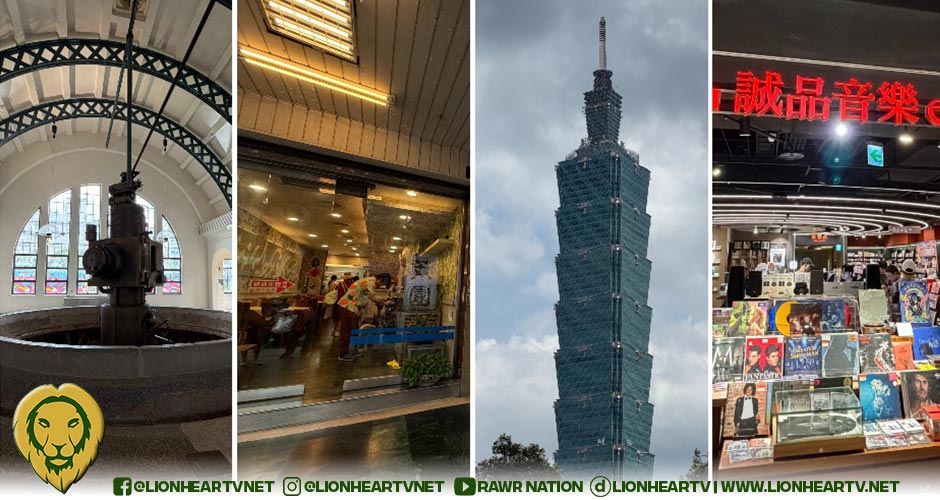
Rather than simply revisiting Taiwan, this year’s Familiarization Trip became an opportunity to discover a different side of the island—one that many Filipino travelers rarely get to experience.
It was my second time visiting Taiwan, having also joined the 2024 Familiarization Trip, but this journey immediately felt different. While Taipei 101, Shilin Night Market, and Jiufen often dominate travel itineraries, this trip was designed to introduce us to lesser-known destinations that reveal Taiwan’s culture, history, creativity, and way of life.

Our adventure began with an early morning departure aboard EVA Air. The smooth flight, attentive cabin crew, enjoyable inflight entertainment, and satisfying meals made the two-hour journey pass quickly. At Taoyuan International Airport, representatives from the Taiwan Tourism Administration and our local guide warmly welcomed our group before taking us to our first meal—a stop that immediately challenged one of the biggest misconceptions about Taiwanese cuisine.
At Great Gobi Mongolian Barbecue, we learned that Mongolian barbecue, despite its name, actually originated in Taipei. Building our own bowls before watching chefs cook them on a massive circular grill was both interactive and delicious, offering our first taste of how Taiwan has made foreign influences uniquely its own.

For the next five days, Two Tails Hotel Luzhou became our home. Conveniently located above an MRT station, it proved to be the perfect base for exploring New Taipei City. On our first evening, we wandered through Luzhou Miaokou Night Market, where local residents outnumbered tourists. Unlike the larger and more famous night markets, this neighborhood market offered a glimpse into everyday Taiwanese life. We also admired Yonglian Temple illuminated against the night sky, quietly standing amid the bustling streets.
The following days unfolded as a journey through Taiwan’s many identities. We admired the newly opened Danjiang Bridge, the final masterpiece of the late architect Zaha Hadid, where engineering meets public art.

We stepped inside Fuyou Temple, where more than two centuries of faith continue to shape the community of Tamsui. At Red Castle 1899, we enjoyed a traditional Taiwanese lunch overlooking the river before strolling through Tamsui Old Street, where history and tourism coexist naturally.

The trip also revealed Taiwan’s remarkable commitment to preserving its industrial heritage. At the National Railway Museum, old locomotives, workshops, and restored train depots tell the story of how the railway helped transform the island. Rather than erasing its industrial past, Taiwan has chosen to preserve it as part of its cultural identity.

That same philosophy is evident at Songshan Cultural and Creative Park, once a tobacco factory but now a thriving hub for artists, designers, entrepreneurs, and creative businesses. Walking through the grounds, it became clear that Taiwan doesn’t simply protect historic buildings—it reinvents them for future generations.

One of my favorite experiences came aboard the Maokong Gondola. Floating above lush mountains while Taipei’s skyline stretched into the distance offered a completely different perspective of the city. Although a thunderstorm warning prevented us from riding the gondola back down, Taiwan’s preparedness ensured our itinerary continued smoothly through an alternative bus transfer.

Of course, no visit to Taiwan would be complete without food. Every meal introduced us to another layer of Taiwanese culture, from Hakka cuisine and seafood banquets to Michelin Bib Gourmand dining and tea-infused dishes served inside a family-run tea garden that has been operating for ten generations.

Even our evenings became adventures of their own. Whether wandering through Ximending’s neon-lit streets or making a late-night trip to Shilin Night Market, we discovered how Taiwan transforms after sunset into a lively blend of shopping, entertainment, and street food.
On our final morning, a visit to Chiang Kai-shek Memorial Hall served as a reminder that Taiwan continues to navigate its complex history while embracing its future.

As our flight back to Manila took off, one thought lingered in my mind. Taiwan is far more than the destinations that usually appear on travel guides. Beyond its iconic landmarks lies a country rich in heritage, creativity, hospitality, and unforgettable flavors. Even after two visits, I left knowing there are still many more stories waiting to be discovered.