

At a time when conversations around HIV remain clouded by fear and misinformation, literature once again proves its power to confront what society often avoids.
During the launch of Stigma, November 28: Mga Batang Poz 2 at Jrich Corporate, award-winning author Segundo Matias Jr. and fellow advocates gathered to highlight how storytelling can challenge prejudice, humanise statistics, and give voice to young Filipinos living with HIV.

Veteran writer Sir Ricky stressed that choosing HIV as a literary subject is not only bold but also necessary.
“Malaking bagay ang gumawa ng nobela tungkol sa subject matter na iniiwasan ng marami. It’s a brave thing to do,” he said, noting that stigma persists despite widespread access to factual information.
Drawing from personal experience, Sir Ricky shared how a former colleague living with HIV was fully supported in the workplace—proof, he said, that compassion is possible. Yet fear remains deeply ingrained.
“Alam ng utak ang totoo, pero sa aktwal na sitwasyon, marami pa ring natatakot,” he added.
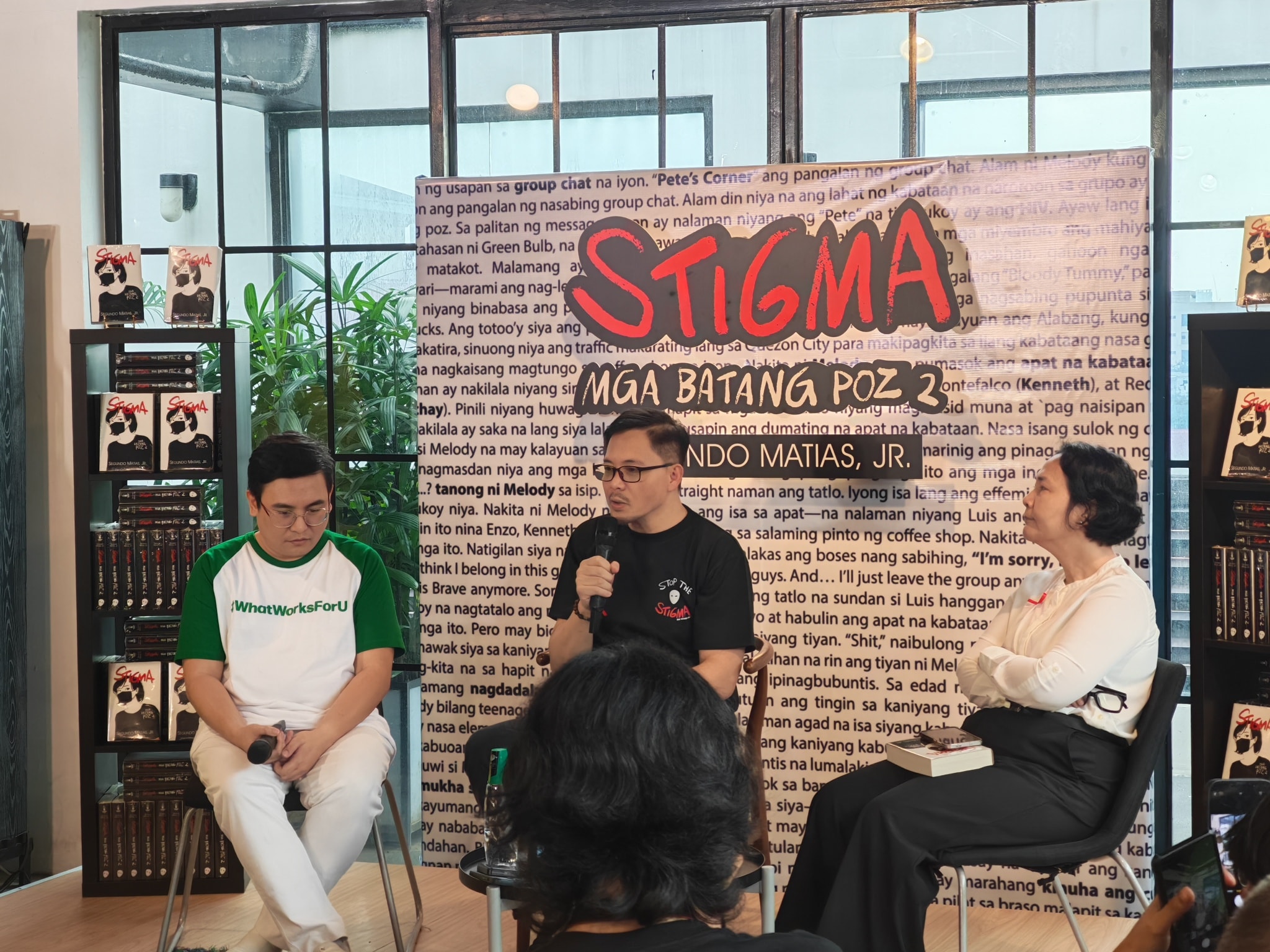
Stigma: Mga Batang Poz 2 is the sequel to Mga Batang Poz (2018), the Philippines’ first young adult novel centred on HIV and AIDS. While the first book explored the shock and fear surrounding diagnosis, the sequel shifts its focus toward resilience, everyday life, and confronting discrimination.
This time, the story is anchored on Melody, a 15-year-old girl who is pregnant and living with HIV. Her character challenges the common misconception that HIV affects only men.
“May na-encounter akong 15-year-old na kailangang ipa-test ang baby niya dahil may HIV siya. That experience stayed with me,” Matias shared during the launch. “That’s where Melody’s story began.”
Through Melody, the novel explores the realities faced by young women living with HIV—fear for their children, judgment from society, and the weight of silence. She reconnects with the original characters—Luis, Enzo, Kenneth, and Chuchay—through an online support group called Pete’s Corner, where shared stories become a source of strength.

The themes of the book mirror an urgent national crisis. The Department of Health has reported a dramatic rise in HIV cases among Filipino youth, with infections increasing by 500 percent in recent years. The World Health Organization has also flagged the Philippines as having the fastest-growing HIV epidemic in the Asia-Pacific region.
Health experts present at the event echoed the importance of early testing and sustained treatment. Dr Rossana Ditangco of the Research Institute for Tropical Medicine emphasised that proper medication not only saves lives but also prevents mother-to-child transmission.
“Treatment protects both the mother and the baby,” she said.

Meanwhile, Danvic Rosadino of LoveYourself Inc. highlighted how support systems play a crucial role once a person is diagnosed.
“Diagnosis is a turning point, but not the end,” he said. “People living with HIV still build relationships, careers, and families—when guided with honesty and care.”
For Matias, writing Stigma: Mga Batang Poz 2 carries emotional weight but also responsibility. Beyond raising awareness, the novel provides clear guidance on prevention, advocating for condom use and access to PrEP, while reframing HIV from a narrative of fear to one of empowerment.

More than a sequel, Stigma: Mga Batang Poz 2 stands as a reminder that behind every statistic is a young life navigating hope, courage, and the desire to be understood.
In amplifying these stories, the book pushes a crucial message: stigma thrives in silence—but understanding begins when stories are told. (with reports from Loyd Pino)
