
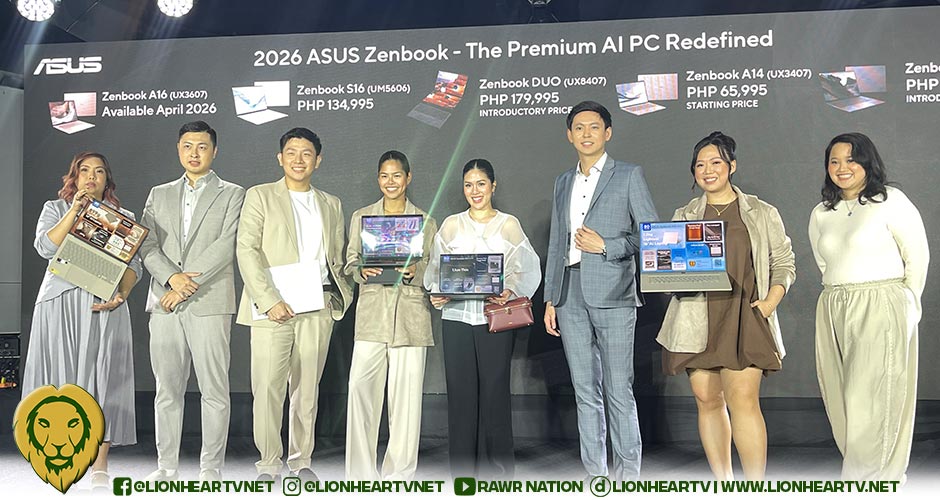
ASUS Philippines officially launched its 2026 Zenbook series, including the Zenbook DUO (UX8407), Zenbook S14 (UX5406), and the newly unveiled Zenbook A16 (UX3607). Who: ASUS executives led by Business Development Manager Harrison Cheng, together with the local product and marketing teams, at Podium Hall, Pasig City.

From the moment guests stepped into Podium Hall, there was a noticeable shift in the event’s feel. Instead of a formal, presentation-heavy program, the space was designed more like an interactive workspace—devices open, screens glowing, and attendees naturally moving between tables to see what “AI-powered computing” actually looks like in real time.
And at the center of it all was a clear message: laptops are no longer just tools for work—they are becoming adaptive partners.
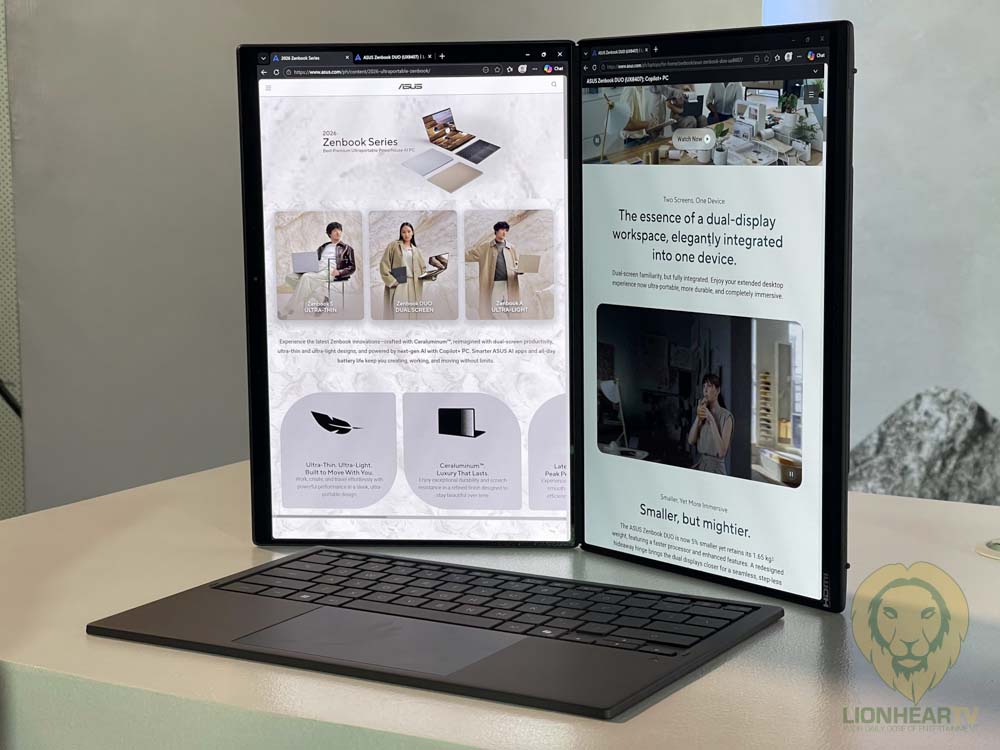
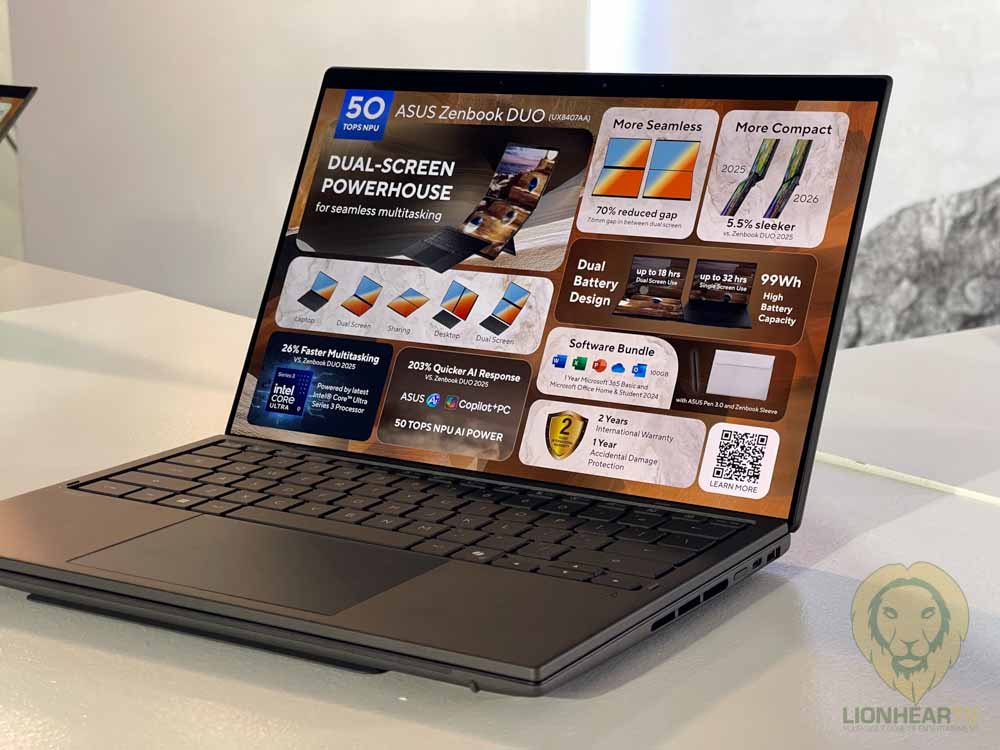
The spotlight first settled on the 2026 Zenbook DUO, a device that immediately drew attention for its dual-screen design. It wasn’t just displayed—it was demonstrated in motion, with guests seeing how seamlessly windows could shift across two 14-inch ASUS Lumina Pro OLED displays.
People leaned in, tried switching modes, and tested how workflows could change depending on the task. The reaction wasn’t just admiration—it was curiosity. The kind that comes when a device starts reshaping how people think about productivity.
With its Intel Core Ultra 9 Series 3 processor, 50 TOPS NPU, and Copilot+ PC capabilities, the Zenbook DUO was positioned as a serious AI-powered multitasking machine. But beyond specs, what stood out was how naturally it handled complexity—almost as if it anticipated what users wanted to do next.
The Zenbook S14 offered a completely different kind of impression.
If the DUO felt experimental and bold, the S14 felt refined and effortless.
At just 1.1 cm thin and 1.2 kg light, it immediately stood out for its portability. But what made it memorable wasn’t just its size—it was the balance it struck between minimal design and serious capability.
The 14-inch 120Hz ASUS Lumina OLED display delivered crisp, vibrant visuals during demos, while the Intel Core Ultra 9 Series 3 processor ensured smooth performance even when AI-driven tasks were pushed in real time.
For professionals moving between meetings, remote work setups, or travel-heavy schedules, it was easy to see the appeal: a device that disappears into a bag but shows up when it matters most.
Then came the Zenbook A16, which closed the lineup reveal with a different kind of energy—larger, more expansive. Yet still remarkably light for a 16-inch device. At 1.2 kg, it challenged expectations almost immediately.
What drew attention was its 16-inch 3K ASUS Lumina OLED display, paired with the new Snapdragon X2 Elite Extreme processor and 80 TOPS NPU, pushing it firmly into the next wave of AI-first computing.
During hands-on moments, the A16 felt like the “big screen productivity” answer to modern workflows, especially for users who prefer more visual space without sacrificing mobility.
Across all three devices, one theme kept surfacing naturally throughout the experience—AI is no longer a feature, it’s becoming the foundation.
That message was echoed during the presentation led by Harrison Cheng, Business Development Manager of ASUS, who described the 2026 Zenbook lineup as intentional upgrades designed to solve real-world needs rather than chase specifications.
Between demo stations and hands-on trials, guests explored Copilot+ features, tested multitasking setups, and experienced how AI integration is becoming more embedded in everyday computing tasks—from writing and organizing to designing and collaborating. (with reports from Lau Balocos)