


The Department of Science and Technology (DOST) and the European Union (EU) continue to explore opportunities to strengthen cooperation in artificial intelligence (AI) research and innovation in the Philippines.

The DOST, in partnership with the EU, co-organized the “EU-PH Advancing Research and Innovation on Artificial Intelligence Mission” recently, highlighting opportunities in AI infrastructure, digital transformation, innovation, and industry collaboration in the country.
“The EU’s leadership in responsible and human-centric AI, cutting-edge research, and innovation offers valuable opportunities for collaboration,” DOST Secretary Renato U. Solidum Jr. mentioned in his keynote message.
He also noted that with European expertise combined with the Philippines’ “dynamic talent pool, growing digital economy, and innovation ecosystem,” the collaboration can “co-create solutions that address shared priorities.”
Emphasizing the department’s ongoing efforts to advance AI, Solidum will focus on climate action, health, agriculture, manufacturing, education, and smart communities, all through this innovation.
“More than advancing AI as a field of research, our goal is to strengthen the institutions, capabilities, and partnerships needed for trusted AI to create meaningful impact across society,” he added.
EU Ambassador to the Philippines Massimo Santoro, on the other hand, emphasized that “AI is shaping our future,” adding that “through the EU Global Gateway initiative, we’re strengthening the EU–Philippine cooperation on AI and innovation.”
PH, EU delegates visit local AI hubs
To showcase the current landscape of Philippine AI, the DOST brought the EU delegations to key institutions around Metro and Mega Manila that stand at the forefront of the national AI initiative.
Among these are the VITRO Data Center, the Philippines’ first and largest AI-ready hyperscale data center and cloud ecosystem in Sta. Rosa, Laguna, and Aboitiz Data Innovation in Makati City, demonstrating real-world enterprise AI applications and responsible technology deployment.
From academe, De La Salle University Laguna’s Knowledge, Innovation, Science, and Technology (KIST) Park exhibited the potential for university-led innovation and talent development in AI, including AI-assisted enterprises and its new undergraduate program, Bachelor of Arts in Philosophy and AI, which focuses on AI ethics, governance, and regulatory considerations.
Along with these institutions, the delegation also set foot at the DOST-Advanced Science and Technology Institute (ASTI) Electronic Products Development Center (EPDC) in Taguig City.
EPDC is a premier facility that supports innovation, prototyping, testing, and product development for startups, enterprises, and academic institutions, particularly on electronic products.
“This (EPDC) is where advanced computing meets electronics research. This is where most national AI efforts play,” Dr. Franz A. de Leon, director of DOST-ASTI, said.
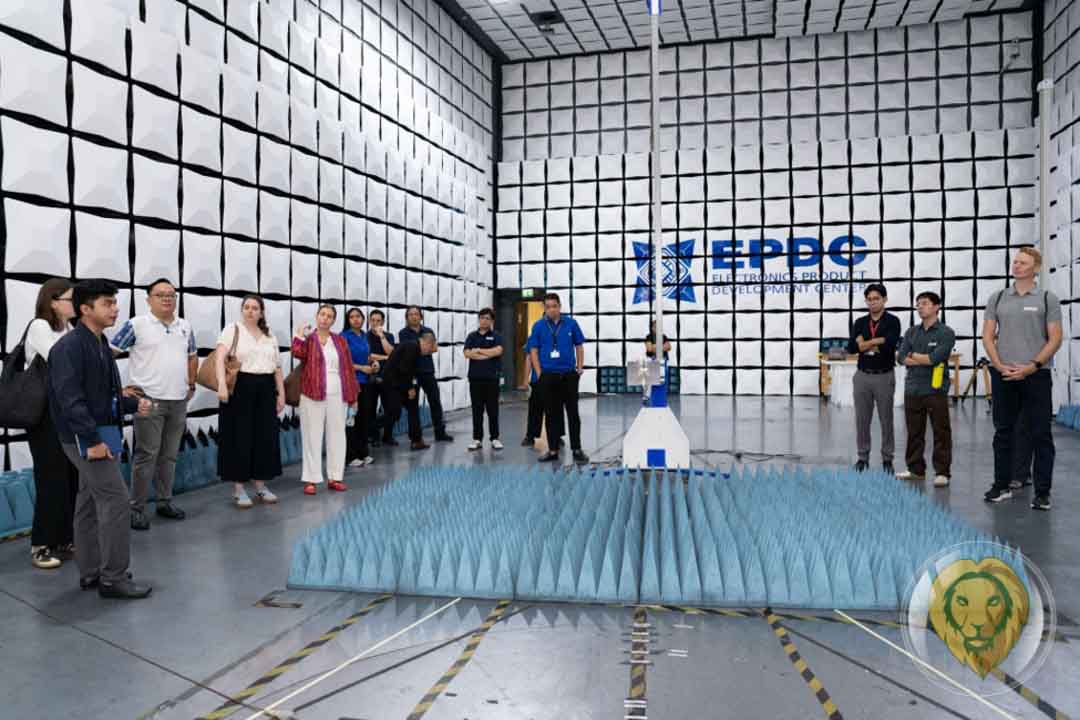
The DOST-ASTI shows off the Electromagnetic Compatibility (EMC) testing laboratory to the EU-Philippine delegation.
PH-EU AI Mission tackles policies, partnership points
The AI mission, during a subsequent two-day plenary session, brought together Philippine and European experts, industry players, government officials, and private sector representatives to discuss the AI top-up initiative under the EU-PH Digital Economy Package (DEP).
The top-up package, worth 10 million euros or 704 million Philippine pesos, is set to support future EU-PH technology, research, and investment initiatives to advance AI policies, governance, infrastructure, and talent development in the country.

An EU delegate asks how the university connects with the university in forwarding AI research and innovation during the visit at De La Salle University (DLSU) Laguna’s Knowledge, Innovation, Science, and Technology (KIST) Park.
This aligns with the present national AI initiative, the National AI Strategy for the Philippines (NAIS PH), which is led by the DOST, focusing on improving lives, expanding opportunities, and enabling sustainable development across sectors through AI solutions.
Through NAIS PH, the DOST launched the National AI Center for Research and Innovation (NAICRI), the Philippines’ central hub for AI research and innovation, last February, aiming to ensure AI-related projects and programs are sustained into national services.
“NAICRI is a national coordination mechanism that aligns infrastructure with policy, research with commercialization, talent development with economic demand, and innovation with inclusive growth,” Solidum explained.
The session also underscored the structural challenges the country faced with Philippine AI, including limited advanced computing power, uneven regional access, and the need for deeper specialized talent.
“This (AI Mission) offers specific advantages for the AI landscape in the Philippines, and they (EU) are experts in the core weakness [we have regarding this],” Assistant Secretary Rodolfo J. Calzado Jr. said.
The DOST urged cooperation with the EU to support the development of a globally competitive AI workforce across government, academia, and industry through public- and private-backed initiatives for talent mobility, upskilling, and reskilling.
Calzado, moreover, mentioned that fragmented government data is also one of the weaknesses of Philippine AI, as isolated datasets cannot be interoperable to create functional AI applications, which the EU affirmed it can intervene in.
He also said the eyed partnership will scale up existing DOST initiatives, such as the Geospatial Analytics and Technology Solutions (GATES) Program, a local data nexus, and the Advancing Computing, Analytics, Big Data, and AI in the Philippines (ACABAI-PH), an AI-powered business adoption platform.
The EU-PH already has a long-standing collaboration, including the Copernicus Philippine (CopPhil) Mirror Site, which was established in 2017 and served as the first data storage and processing hub in Asia, facilitating near-real-time satellite data access.
Following it with the DEP, the EU provides physical investment to connect the CopPhil directly to the national data lakehouse being built through the GATES program for local disaster risk management, ground motion, and marine-land analysis.
Currently, the EU-Philippines partnership is seeking to focus on integrating data for AI-powered use cases for sectors such as health, agriculture, and disaster resilience.
“Not everyone is investing in these technologies. But these are essential for us to be able to move towards the future,” Calzado emphasized.
Meanwhile, Solidum reminded that advancing with AI must ensure that innovation remains anchored on shared values, saying that “AI should be ethical, transparent, secure, and inclusive.”
This partnership conducted with EU delegation in advancing AI technology in the country is one of the many initiatives of the DOST aimed at providing science-based, innovative, and inclusive solutions across four strategic pillars: human well-being, wealth creation, wealth protection, and sustainability. These pillars embody the mantra OneDOST4U: Solutions and Opportunities for All. For more information, visit www.dost.gov.ph.
