
The Philippine Space Agency (PhilSA) and the Japan Aerospace Exploration Agency (JAXA) signed a Joint Declaration of Interest in Space Cooperation on 27 May 2026, reaffirming their shared goals and objectives, and their interest in exploring cooperation and industry partnerships in Satellite Joint Mission Partnership and Data Applications, Space Exploration and Human Spaceflight, and Space Sustainability.
The declaration was signed by PhilSA Ad Interim Director General Gay Jane P. Perez and JAXA President Hiroshi Yamakawa during President Ferdinand R. Marcos Jr.’s state visit to Japan.
“As we mark the 10th anniversary of the launch into orbit of the Diwata-1 microsatellite from the Japanese module of the International Space Station this year, we are reminded of how our partnership has quite literally reached new heights, symbolizing our shared commitment to innovation, science, and the industries of the future,” said President Marcos at the Summit Meeting with Japanese Prime Minister Takaichi Sanae on 28 May.
The Philippines and Japan have a strong history of cooperation in space activities. In November 2025, PhilSA and JAXA co-organized the 31st Asia-Pacific Regional Space Agency Forum (APRSAF-31) in Cebu, the largest space forum in the region, attended by President Marcos.
“Across the Asia-Pacific, nations are turning to space science as a means to improve governance, protect the environment, and to champion inclusive development. In the Philippines, PhilSA has been at the helm of our progress in space science and technology over the past six years. They regularly generate and distribute satellite data to national and local governments, researchers, and of course the private sector. These are used to aid disaster risk reduction and management as well as monitor the country’s maritime domain, among other functions. . . All these initiatives are guided by a simple conviction: Space must serve the people,” shared President Marcos during the conduct of APRSAF-31 last 21 November 2025.
This year also marks twenty years of Sentinel Asia, an international cooperation project led by JAXA and the Asian Disaster Reduction Center (ADRC) that contributes to disaster management in the Asia-Pacific region. Launched in 2006 under the APRSAF, it provides a framework to request and utilize satellite data for rapid disaster assessment and response. From 2024 to 2025, a total of 20 emergency observation requests were made through Sentinel Asia by different Philippine institutions: PAGASA, PHIVOLCS, MGB, and PhilSA. Most of these requests were related to floods, landslides, and storms; two were for earthquakes; one for an oil spill; and one for volcanic activity.
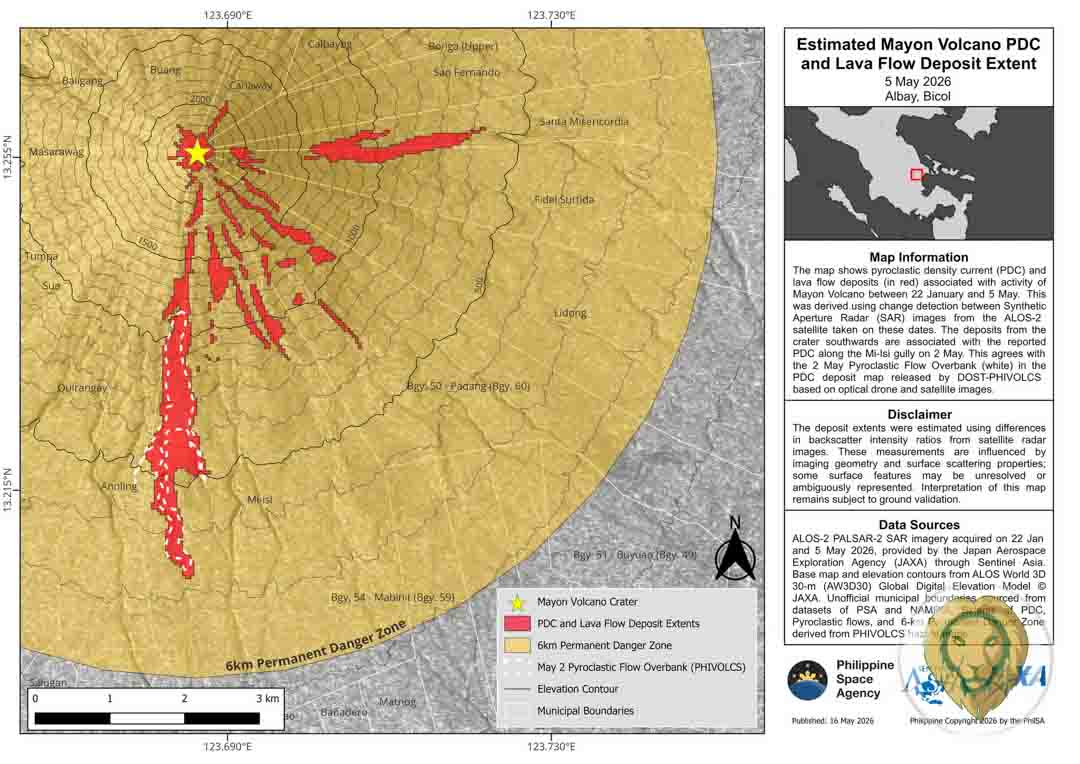
For a recent example, JAXA provided data from its ALOS-2 Synthetic Aperture Radar (SAR) satellite through Sentinel Asia for the 2 May Mayon Volcano pyroclastic density current (PDC) event. Using ALOS-2 SAR images, PhilSA mapped the extents of the PDC and lava flow deposits (shown in red in the map) from volcanic activities that occurred between 22 January 2026 and 5 May 2026. The SAR data from JAXA enabled mapping of these deposits even in areas obscured by cloud cover or inaccessible to drones and field surveys.